

22 September 2013
Still Rockin'
21 September 2013
Bolivia
Reuploaded 11/27/2025

There has been much
written elsewhere about the absolute coolness factor of this rare el go-gó
& sicodelico from late 60s Bolivia.
I’ll try to just give a bit of info about the various outstanding groups found
here.

First an intro commercial for Inca Kola, then...
Fourteen songs from
1966-1969, mucho fuzz, primitive but great productions. Most tracks are covers:
the Dhag Dhag's take on "One Track Mind" by The Knickerbockers; Grupo
606's takes on "Break On Through" by The Doors & "Gotta Get
Away" by The Blues Magoos; Los Ecos do Rufus Thomas' "Walk That
Walk"; The Loving Darks cover The Rolling Stones' "Complicated"; Los
Burros fuzz out The Rascals' "You Better Run"; while Los Bonny Boy’s
Hot’s (???) cover Peruvian Andino hit of Jorge Bravo de la Rueda/Yma Sumac. The
original songs are also impressive, like the punker "Pena" by The
Blackstones or the somber "Tipo sicodélico" & the swinging
"Bohemio" both by the Dhag Dhag's.
Los Daltons – They came out of
Santa Cruz de le Sierra around
1967. In 1968 they released a four-song instrumental EP.
Due to the 11:00 pm electricity cut-off, they did without a
singer who would need a microphone. These instrumentals,
led by a crazed merry organ, didn’t need vocals. This album starts
with their version of the Ventures
“ High & Dry” only here they were referring to the
high & dry plains of the Bolivian Altiplano.

The Dhag Dhags - Behind this
untranslatable name hides a undeniable gem: one of the best
60s beat bands in the world. The
Dhad Dhasgs were a
trio of teenagers from La Paz led by the brilliant Javier Sandoval.
In 1968 he released his first EP on the "Psicofásicos" division
of the Discos Mendez
label. "Trata de Comprender” (Try to Understand)
is their version of "One Track Mind" by The Knickerbockers. "Type Sicodélico" is an original composition,
written in English, probably the first
recording of psychedelic music in
Bolivia.
Its spectral atmosphere
is reminiscent of the Peruvian group Los Saicos. On "Bohemio"
Sandoval mocks the local conservatives
by creating a 'groove' that caused every El Go-Gó girl from La Paz to Santa Cruz to go crazy.

Los Ecos – The crazy drum beats & shrill cries
you hear coming out of this band come from Terso, the 11 year old girl on drums
in this band. She & her three companions, revel in the infernal hully gully
beat. They began performing in mid-1967. On this disc they do their version of
"Walk That Walk" by Rufus Thomas. In 1968, the band had achieved
national success with their magnificent song "Callaré Simplemente".
The Blackstones – Here we have another trio originally
from Santa Cruz, they moved to Cochabamba & recorded an EP on Psicofásicos
in 1969. Here they do their version of "Pain" by the Walkers sung by
JC Lugones "Pena" is a typical case of teenage frustrations brutally
played in the best three-chord tradition on screaming electric guitar.
Minimalist, crude, neurotic punk from Bolivia before there was punk.
Los Tennyson – There is not much information about
these poets. They are kind of a mystery band. They are probably from Cochabamba or Oruro.
They had a single in 1967, a version of The Twist. The song here was taken from
their EP Psicodélico recorded on the Lyra label in 1969.

Grupo 606 - In late 1966, three friends from school
in Cochabamba
formed this great band. At first they just played at local parties with
instruments made by themselves. At one of their shows in 1967 they met Oswaldo,
a radio announcer & singer. He joined the group & got them a recording
contract with Lyra. At the beginning of 1969, these chavalitos (only 17-19
years old) released their second EP, demonstrating their best & angeriest garage
style. They play their version of "Break on Through" by The Doors on the
first side & open the B side with a sublime version of "Gotta Get
Away" by The Blues Magoos.
Los Burros - Started in 1967, Los Burros was one of
the most successful bands from Bolivia.
Originally from Santa Cruz de la Sierra, this band was formed with members of
Los Vandalos & Fire Hearts. Once they got a little notoriety, the moved to La Paz where the soon frightened
the conservatives. They rode around in their Prado jeep painted Rolls-Royce yellow,
wearing baggy pants & floral shirts. They sang in Spanish, Portuguese, &
Italian. They recorded “El Pobre”, their version of the Spanish band Los Pasos’
tune, in September 1968. That same year they were arrested by the army as
suspected guerillas supporting Ernesto ‘Che’ Guevara because they had beards
& long hair. By the way, Los Burros are the guys on the cover. Their second
song is their version of "You'd Better Run" by The Young Rascals.

Los Bonny Boy's Hots – They were the first well-known
electronic band in Bolivia.
They worked on a lot of records accompanying singers for Lyra, but their most
interesting releases were their reworked & roomy recordings of various
artists. On this album they do a version of the famous song composed by Jorge
Bravo de la Rueda that was popularized by Yma Sumac, done to go-gó tempo. The song is about the mythical Incan Sun
virgins of the sixteenth century. Recorded in 1966, this instrumental was a
success in Bolivia.
It ushered in a spate of traditional
Incan songs set to the go-gó
pace.
The Loving Dark – Here
they are named The Loving Dark, but on their first EP they are called Amantes
Oscuros (Dark Lovers). The
group was formed in La Paz
by Argentinean guitarist-singer Felix Chavez & Bolivian drummer Boris
Rodriguez in the year 1969. Chavez was originally in the band Las Tortugas .Rodriguez
in Los Black Byrds, one of the pioneers of rock groups in Bolivia. They recorded three EP's
for Lyra by 1972. This version of "Complicated" by the Rolling Stones
comes from their second EP from late 1969. Their play sound has been described
as ‘BIG’: great guitar fuzz, demonic drums, groovy organ & bass at least 10
years ahead of their time.

Los Grillos – Los Grillos are probably the most
famous group of this compilation. Los Grillos began in 1967 under the name anglicized
name The Crickets in Cochabamba.
Shortly after forming, they changed their name to the Spanish Los Grillos. They
played the current popular dance music & they achieved great successes. They
regularly appeared on Bolivian & other South American television. They recorded
at least 20 EP's for Lyra & later their own label Grillo. In the 70s, they
played their own unique style of folk-rock with Andean sounds & Moog
synthesizers. The song here dates from 1968. It is one of their early
recordings. It is a famous Spanish popular song with lyrics by Federico Garcia
Lorca. However, the guitar solo make it worthy of inclusion here.
This album was re-released
in 2009 on CD.

Various - Psicofásicosde Bolivia, Discos del Condor cóndor001, 2003.
Lado A –
Intro - Inca Kola
Alto y Seco – Los
Daltons
Trata de Comprender – The
Dhag Dhags
La Gran Pelea – Los Ecos
Pena – The Blackstones
Un Mundo Para Mi – Los Tennyson
Rompe, Cruza o Ayudame –
Grupo 606
Tico Sicodélico – The Dhag
Dhags
Lado B –
Busco un Camino – Grupo
606
El Pobre – Los Burros
Es Mejor Que Corras –
Los Burros
Virgenes del Sol – Los Bonny Boy’s Hots
Complicado – The Loving
Dark
La Tarara – Los Grillos
Bohemio – The Dhag Dhags
Enjoy,
NØ
19 September 2013
Paraguay
Reuploaded 11/27/2025

Until recent years,
there wasn't much in the way of modern music coming out of Paraguay. Between the years 1954 to
1989 Paraguay
was under the fierce dictatorship enforced by former President Alfredo
Stroessner. He banned all forms of liberal expressions. It wasn't really until
after Stroessner's downfall in 1989 that modern music began to emerge. In the
1990s groups such as Chris Patik, Enemigos de la Klase, Gaia, Deliverans, El
Templo, Dogma, Shamán, Turkish Blend, & Slow Agony became popular. In the
new millennium, Paraguayan rock bands have gained a strong following thanks to the
big rock festivals such as Pilsen Rock & Quilmes Rock, which gather around
60,000 spectators each time they are held.

Enemigos de la Klase is
a punk outfit that formed in mid-1992 in Paraguay. The founding members
were: Felipe Fernandez – vocals; Juan Armano – guitar; Sargus Perez – bass;
& Christian Perez - drums. The bands original name was Los Birramaníacos or
The Beer Maniacs, but they quickly changed their name to Enemigos de la Klase
or Enemies of the (Upper) Class to be more directly in line with their ideological
concept of the band, of their identification with the oppressed, the exploited,
those fighting every day for their freedom. They are the enemies of the bourgeoisie
, the capitalists, the class that only protects the interests of their money.
They sought to address the social problems & politics of Paraguay &
Latin America in general.

In 1993 they entered the
studio to record their first demo with the songs "República o Muerte",
"Nuestras Vidas",
& "Nunca"
(unpublished). This first demo helped the group become better known in Paraguay
& got them some radio airplay. Shortly after the demo is recorded, Felipe Fernandez leaves the group so Christian, who
writes most of the material, takes over on vocals &.
Roberto Bernal joins
on drums. Then Juan Armano leaves
& is replaced by Carlos Acuña om guitar. By 1994 they
had written more songs & the demo was now 9 tracks. ENSA label issued the
release in cassette format in 1995. After the cassette is released, Carlos Acuña left the band. Then Christian Pérez
also takes over on
guitar, making the group a trio. Christians brother Sargus & Roberto Bernal then
quit, leaving only Christian. He enlists the help of long-time friend Marcelo Gonzalez on drums & they recruit Eduardo Anderlique
to play bass. It wasn’t until 1998 that they were
able to release República o Muerte on CD. It had now grown
to 10 tracks. Some time in 2000, Eduardo Anderlique leaves the band so
Christian & Marcelo seek out Miquel Loaiza to play bass & Lolo Ferreira
as second guitar. Most recently Lolo & Miguel quit the band & Delis
Castro signed on to play bass. They have stayed with this three man line-up since,
& continue to play.

Enemigos de la Klase - República OMuerte (Republic or Death), ENSA, 1998.
Tracklist –
Patria querida
Enemigos
Nuestras vidas
Maria Juana (un amor
illegal)
Manifesto
República o muerte
Te Quiero en mi cama
La paz de los muertos
Alcohol amargo
M.J.
This band reminds me of a Paraguayan version of Calexico.
They call their music urban folk, but I call it great.
In 2006 , Mario
Halley, Fernando Peyrat, Roberto 'Chirola' Ruiz Diaz, &Julio Troche, who
had been friends for more than 10 years, decided to get together in the back of
Fernando’s house for Friday night jam sessions which they dubbed Terapia de los
Viernes or Friday Therapy. It all started when Julio started taking drum
lessons at Fernando’s & they invited their other two friends over, with a
simple goal, to make a little music. Fernando Peyrat had been in two bands, Partes
Iguales (Equal Parts) & La Sociedad (The Society). Playing in these bands
had given him the opportunity to play alongside great local musicians Rodrigo 'Yuka' Ojeda & Gustavo Gomez.

In August 2006, Mario had written a song called "Bandida" (Bandit) that he thought the four should record. With the help of Yuka Ojeda (formerly of the group La Sociedad) at his home recording studio in Pedro Juan Caballero, near the Brazilian border, the four friends recorded their first demo versions of "Bandido" & "Guarani Cool" both of which would later appear on the bands first release. Encouraged by the results of that first recording session, the four invited five of their friend to El Santo, a local disco, for an audition/jam. All five friends answered the call to see what it was & subsequently became members of the new 9-member urban folk band K-Chiporros. The new members were: Rodrigo 'Yuka' Ojeda - lead guitar; Edgar Aquino – bass; Eugenio 'El Loco' Barath – keyboards; Gustavo Gómez – percussion; & Pedro Elias Fadul - electronic drums.
On November 25,
2006 the band played their first gig at El Santo & as they say, the rest is
history…
The following
year they released their 5-song freshmen disc Guarani Cool. This is their
sophmore release, 2008s self-titled disc. It has a more refined sound. It
really highlights the band skills in songwriting, singing, & musicianship.


Kchiporros – Kchiporros, 4Kcho Records, 2008.
Tracklist –
Hueso Oficial
Volver a nacer
Me estoy enamorando
Noche de soltero
Algo de ti
Tuchaite
Loco de amor
Sólo con un poco
El ventilador
Punkchak
Ya no importa
Manuel
Because I love you
Celoso
Se van
Enjoy,
NØ
18 September 2013
Uruguay
Reuploaded 11/27/2025

The most distinctive music
of Uruguay
is to be found in the tango & candombe; both genres have been recognized by
UNESCO as an Intangible Cultural Heritage of Humanity.
Candombe originated from the Río de la Plata region, from
music African slaves brought with them to the New World, from
their dances & from their percussion music.
Popular candombe musicians include Hugo Fattoruso & Rubén
Rada. Fattoruso has been a longtime part of the Uruguayan & Latin American
music scene. He was a member of the rock band Los Shakers who I will post
below.
Candombe-beat
began in the late 60s with El Kinto, a band featuring Rubén Rada & Eduardo
Mateo. Emerging at the same time as Los Shakers, they forged their own identity
with very little Western influence.
Here for your edification are fourteen crucial tracks by these
Uruguayan legends. The band’s line-up included members of various
popular Uruguayan candombe bands. It also featured the compositional skills of
poet/panhandler & acid casualty Eduardo Mateo (Ángel
Eduardo Mateo López) along with his alter-ego, candombe legend Rubén Rada. El Kinto began their brief but eventful
life in music playing in the dark shadows at Orfeo Negro (Black Orpheus), a
night club near the Portones de Carrasco in Montevideo, Uruguay.
Inspired by the way Tropicalistas like Os Mutantes were transforming the pop
music of Brazil,
El Kinto embraced their own native music forms. They integrated candombe &
bossa nova into beat music, but they also added their own notion of 'psicodelics'. They experimented with new sounds from their guitars, new types
of vocal delivery, new ways of striking the drums (with little brooms, with
gavels, or their hands).

The beat of candombe formed the rhythm, bossa nova played a
large role in its chords & structure, as did traditional Uruguayan folk
music.

In 1964, Miguel Mattos formed the band
The Hit Fingers. After a few
personnel changes, Mattos changed the name to The Damned with Walter Cambón &
Eduardo Mateo on guitars, Ernesto Soca on piano, Mattos playing bass, &
Carlos 'Chango' Castro on drums. Between 1964
& 1966 they were active in Montevideo as
well as Buenos Aires.
In 1966 they again changed their name to The Knights
& recorded an album of original songs (sung in English) for the label Sondor.
Shortly after the recording was made Miguel Mattos left & Rubén Rada joined the group as singer & conga player with
Luis Sosa on drums & Antonio 'Lobito' Lagarde on bass. Ernesto decided to
go in a more electrified direction & once again the group changed its name,
this time to El Kinto Conjunto though they would be known simply as El
Kinto.

In 1968, Urban Moraes joined El Kinto, replacing
Lobito Lagarde on bass. At the same time Rubén
Rada left the band & Mario "Chichito" Cabral joined as percussionist.
This left an obvious gap on vocals, so Eduardo Mateo, Urban Moraes, & Walter
Cambón took up vocal duties.

When the group finally dissolved in 1970, the line-up was Mateo on guitar & vocals, Walter Cambón on guitar, Urbano
Moraes on bass & vocals, Chiche
Cabral as percussionist, & Luis Sosa on drums. After El Kinto called
it quits, Rubén Rada, Chiche Cabral,
& Lobito
Lagarde formed the band Totem. Walter Cambón
& Luis Sosa formed Limonada. Both groups
became very popular candombe-beat bands. Urbano Moraes went on to a successful solo
career. Eduardo Mateo died in 1990, having composed & recorded a
vast catalogue of fantastic music that is well worth seeking out.
As one journalist noted in 1969, "El Kinto, directed by the
brilliant Mateo, and amplified to the maximum... creates a frenzy of rhythmic
music in which—with force and conviction—pure wave ‘beat’ is synthesized with
the warmth of the African drums."
The result of the group’s tireless experiments is music have stood the test of time & still sounds fresh & engaging today.

El Kinto – Circa 1968, Clave 72-35066, 1977.
Lado 1 –
Don Pascual
Muy lejos te vas
Voy pensando
Siempre vas
Estoy sin ti
Yo volveré por ti
Lado 2 –
José
Mejor me voy
Ni me puedes ver
Suena Blanca espuma
Dámelo
Principe azul
Pippo
=======================================================
Los Shakers formed in 1963 in Montevideo, at the
suggestion Hugo & Osvaldo Fattoruso’s uncle. Hugo Fattoruso - piano,
guitar, & vocals & his brother
Osvaldo Fattoruso - guitar & vocals hooked up with
Roberto ‘Pelin’ Capobianco - bass & vocals, & Caio Villa - drums.
They started out playing jazz &
avant-garde music at nightclubs like The Hot Club of
Montevideo for a while. However, Beatlemania was
sweeping through South America at the time,
& the lads wanted their own ‘Fab Four’ group.
The influence The
Beatles had on the group can be heard in their earliest releases & can be
seen in the photograph below, from early 1965.

They moved to Buenos Aires in search of a recording contract with a major labels &
almost immediately signed with the label Odeon Pops. In 1965 they released their first album, the self-titled Los Shakers.
For their second album Shakers
For You their playing was more sophisticated,
introducing new elements to the band's style, especially
psychedelia.
By the time they recorded their last studio album for Odeon
in 1968, La Conferencia Secreta del
Toto's Bar, their music had gone in a new heavier direction. On Toto's Bar their sound was that of psychedelic music mixed with candombe & tango
sounds. Odeon was not happy with the new direction & left the group without
any promotion or support. At this time the band broke up & Hugo &
Osvaldo went on to their own projects in Rio de la Plata.
Osvaldo died of cancer in July 2012.
The album Los Inéditos de… was released in 1977 after the
band had split up, but as the name implies, these were inéditos (unpublished or
unreleased tracks from the original band).

Los Shakers – Los Inéditos de Los Shakers, EMI 6186, 1977.
FAZ A –
Hasta Luego Cocodrilo
La Larga Noche
Dame
My Bonnie
Dejame Ir
Que Amor
Submarino Amarillo
FAZ B –
Esta es Mi Fiesta
No Fuimos
Solo Quiero Estar Contigo
Pelota de Goma Roja
Nena Baila Shake
Estoy Pensando
Quiero ser Tu Hombre
Enjoy,
NØ
17 September 2013
Argentina
Reuploaded 11/27/2025

2 Minutos is an
Argentine punk band formed in Valentin Alsina in 1987. Valentín Alsina is a
city in the Lanús Partido of Buenos Aires Province, Argentina.
It is located next to Buenos Aires
in the Gran Buenos Aires urban area. 2 Minutos played their first gig on July 8,
1989, the same day that Raúl Alfonsín was forced out of office early due to rioting
after the election of new neo-liberalist Peronist candidate Carlos Menem. They
are probably the most popular punk band in South America
& across most of the Spanish speaking world. They are also very popular in
the U.S.
They have opened for Motorhead in Vélez before 45,000 spectators & for the
Ramones at River Plate for their Global Farwell '96 tour with a stage on the
verge of exploding. They even sold out legendary punk venue CBGBs during their
95 U.S.
tour.

The original group consisted of: Wálter 'Mosca' Velásquez –
vocals & guitar; Luis Aguirre vocals & guitar; El Indio – guitar; Alexander 'Papa' Aidnajian – bass; & Marcelo – drums. 'Mosca'
& 'Papa' are the only original members of the band left. Their present
members are: Wálter 'Mosca' Velásquez – vocals;
Alexander 'Papa' Aidnajian – bass; Marcelo 'Pedro' Pedrozo & Pablo 'Coll'
Velmondo– guitars; & Monti 'Burns' Montaña – drums.

Valentin Alsina is
the title of their first release, in recognition of their city of origin. They
had a hit with the song "Ya No Sos Igual" , a song about a
neighborhood kiosquero or newsstand owner who also worked for the Federal
Police. The majority of the songs on their album tell of the district they grew
up in, the reality of the wage-slaves crushed by the low wages & the
extensive working hours. The band sold 50,000 copies of this first release.
They got to open for Motorhead in Vélez before 45,000 spectators & for the Ramones
at River Plate for their Global Farewell '96 tour with a stage on the verge of
exploding. They even sold out legendary punk venue CBGBs during their 95 U.S.
tour.

2 Minutos – Valentin Alsina,
Interdisc 522 560-2, 1994.
Tracklist –
Valentín Alsina
Canción
De Amor
¡
Que Mala Suerte!
Novedades
Odio
Laburar
Amor
Suicida
14
Botellas
Vos
no Confiaste
Barricada
Otra
Mujer
Como
Caramelo de Limón
Demasiado
Tarde (La Marcha)
Pelea
Callejera
Arrebato
Ya
No Sos Igual
Their second release Volvio
la Alegria Vieja was recorded in 1995. This disc contains hits like "Tema
de Adrian", "Vago", "Todo lo Miro", & "Piñas Van, Piñas Vienen" (a tribute
to famous Argentine boxers).

2 Minutos - Volvió la Alegria Vieja!!!, Interdisc 528285-2, 1995.
Tracklist –
Copetín
Al Paso
Todo
Lo Miro
Ataque
Tema
de Adrian
Borracho
Y Agresivo
Laburantes
Mosca
de Bar
El
Mejor Recuerdo
Vago
Otra
Vez (La Casa de Juán)
Piñas
Van, Piñas Vienen
Q.E.P.D.
Their third album was entitled Postal
'97. It was
released in mid-1997, celebrating
the bands 10 year anniversary. "Gatillo
Fácil" (Trigger Happy) was first single. The album sold 15,000 copies the first month after its
release, prompting their label to renew their
recording deal.

2 Minutos - Postal '97, Interdisc 536289-2, 1997.
Tracklist –
Qué Yeta
1987
El Se Va
No Mientas Más
La Balanza
Mal Romance
Recuentos En La Arena
A Veces
Los Chuquis
La Ladrona
Domingos
Postal ‘96
Gatillo Fácil
Los Ladrones
Nada Que Hacer
Pequeño Gran Héroe
Their fourth album, Dos Minutos de Advertencia (2 Minute Warning) was released in 1999. It contained the hits "Lejos Estoy" (I
am Far Away) & "Carta a E.T." (Letter to E.T. - a song about
pollution & global warming).

2 Minutos – Dos Minutos de Advertencia, DBN CD 51602, 1999.
Tracklist –
Hambruna
Lejos Estoy
Canción Para Mi Muerte
Destino
Mi Marca
Surfer’s Punk (Aquaman)
No Me Moleste
In the Street
Ska de la Rutina
Casa de Dos
Correo de Amor
Naif
Perdiendo el Tiempo
Carta a E.T.
Un Mundo de
Sensaciones was recorded in
2006. It was produced by Juanchi Baleiron of Los Pericos. On this release, 2
Minutos was aided by guest musicians Sebastián Teysera of La Vela Puerca, Diego
Blanco & Juanchi ( Los Pericos ) & Claudio O'Connor.

2 Minutos - Un Mundo de Sensaciones, Sony music 8287 686797, 2006.
Tracklist –
2 Minutos
Cacería
Pandora Box
Un Sueño
Foto Rosada
Las Piedras Rodantes
Aeropuerto
El Bondi
Planetas
Miss Muerte
Soledad
Somos Más Americanos
Niño
Cero
Rompan Todo
Vamos A La Granja /
Directo Al Infierno (Let's Go to the Farm / Straight to Hell) is the bands eleventh
album. It was recorded, mixed, & mastered between December 2009 &
January 2010, at El Parral Studios in Buenos
Aires. Track 20 is a cover of the Clash tune "Straight
to Hell".

2 Minutos - Vamos A LaGranja / Directo Al Infierno, Sony Music 8869 763476-2, 2010.
Tracklist –
Panik Atack
Cabeza de Limón
Especial (Ella)
Navaja
Resfriada
Melodía de Barrio
A.X.E. (Amnesia Por Ebriedad)
Paro General
Metal Marciano Rojo (Musa)
Todavía una Canción de Amor
900 Muy Bien
Fantasma
El Que no Salta es un Skon
Ave de Paso
El Asador
Guitarrita y Fafa
Esto no es el Italpark (La Caprichosa)
Maravillosa Mente
Efedrina
Straight to Hell
Vamos a la Granja
Enjoy,
NØ
16 September 2013
Chile
Reuploaded 11/27/2025

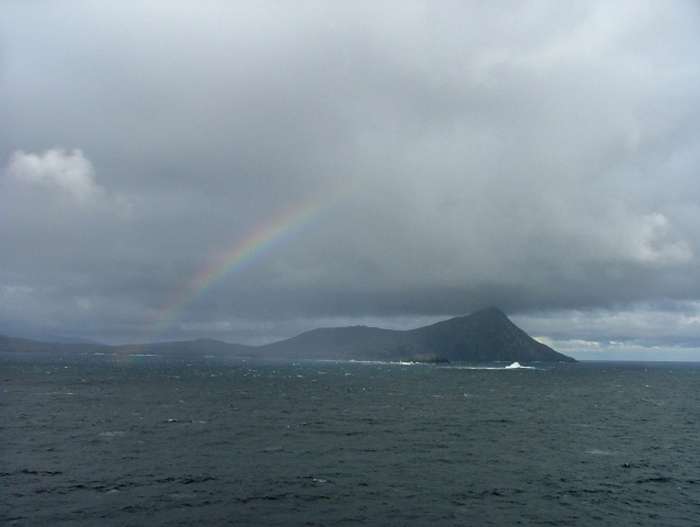
Man, am I seasick. Five thousand miles across the unforgiving Southern Pacific to the treacherous Cape Horn. Sudden squalls & rain showers continued to dog me through the night. I am now getting dangerously close to the ice fields. The wind is howling at 30-40 knots & the waves are building up to 20 feet as I cross Drake's Passage. Because of the westerly winds, I am forced to approach Cape Horn from the south-west. I will have to avoid the Diego Ramirez Islands, situated just 60 miles SW of Cape Horn. I approach just as day breaks & the storm lifts a little. A beautiful rainbow appears in the sky & I see my goal…Terra Firma…finally solid ground. Hello Chile, S.A.
Today Chile is one of South America's most stable & prosperous nations. It leads all other Latin American nations in human development, competitiveness, income per capita, globalization, state of peace, economic freedom, & democratic development. But such has not always been the case. The late 60s until the late 80s was a tumultuous time for the Chilean people.
The 1964 presidential election of Christian Democrat Eduardo Frei Montalva initiated a period of major reform. Frei’s administration embarked on far-reaching social & economic programs, particularly in education, housing, & agrarian reform, including rural unionization of agricultural workers. But by 1967 however, Frei was encountering increasing opposition by those on the left, who charged that his reforms were inadequate, & from the conservative right, who found them excessive. At the end of his term, Frei had not fully achieved his party's ambitious goals.

In the 1970 election, Salvador Allende of the Socialist
Party of Chile ended up stuck in a three-way contest with candidate Radomiro
Tomic for the Christian Democrat Party & Jorge Alessandri for the
Conservative Party. The Chilean Congress conducted a runoff vote between the
leading candidates which Allende won. The economic depression in Chile in the
early 70s was harsh, but Allende adopted measures including price freezes, wage
increases, & tax reforms to increase consumer spending & redistribute
income downward. Joint private-public works projects helped reduce
unemployment. Much of the banking sector was nationalized. Many enterprises
within the copper, coal, iron, nitrate, & steel industries were expropriated,
nationalized, or subjected to state intervention. Industrial output increased
sharply & unemployment fell during the Allende administration's first year.

As a result, the Richard Nixon administration, fearing the
success of a Socialist Republic, organized & inserted secret CIA operatives
in Chile,
in order to quickly destabilize Allende’s government. In addition, American
financial pressure restricted international economic credit to Chile. With the
intrusion & subversion of the United States,
by early 1973, inflation in Chile
was out of control. A military coup overthrew Allende on September 11, 1973. As
the armed forces bombarded the presidential palace, Allende reportedly 'committed
suicide'. A military junta led by
General Augusto Pinochet Ugarte took over control of the country. The first
years of the regime were marked by extreme human rights violations. On October 1973, at
least 72 people were murdered by the Pinochet’s Caravan of Death. In all, at least
2,115 were killed, at least 27,265 were tortured (including 88 children younger
than 12 years old). Many were forced to flee for their lives.

Among those forced to flee were the band members of Los Jaivas.
If I didn’t post up some music from Chilean band Los Jaivas, then I'd be doing a disservice to this journey. Los Jaivas first appeared on the Chilean music scene in 1963 & have been going strong to this day, now fifty years worth of fantastic prog-rock blended with native Andino folk, successfully mixing rock with South American Andes ancestral music.

The Parra brothers met Mario Mutis & Eduardo 'Gato' Alquinta when they were all still children. They joined together through their love of music. They got their first tastes of fame in Viña del Mar, Chile playing at many area parties & shows.
The band took refuge in Argentina after the military dictatorship took over in Chile in 1973. The first major line-up change for the band occurred in 1988 when Gabriel Parra died in Peru in a car crash. His daughter Juanita took his place behind the drums.
In January 2003, their lead singer Gato Alquinta died in Coquimbo, Chile of a heart attack while swimming in the ocean. After his death, Gato's three sons joined the band to help keep Eduardo’s memory & the band itself alive: Ankatu – guitar; Eloy – saxophone; & Aurora - vocals. Aurora left shortly after, & Eloy died of a heart attack in 2004. Ankatu is still a member of the band & they continue onward.

This first album was originally titled Los Jaivas, but the
year following its release (privately by the band) they released an album also
titled Los Jaivas on the IRT (Industria De Radio y Televisión, S.A.)
label. So when the first album was re-released, the title was changed to El
Volantin. To add to the confusion that we so enjoy here, the IRT release Los
Jaivas had its titled changed three times. It was re-released in 1983 in Argentina,
where the band had moved after the military dictatorship took over, as La
Ventana. It was once again re-released, this time in 2002, again in Chile, as Todos
Juntos, & last year it was re-released again on RCA Victor Chile, now back
to Los Jaivas.
This first album was recorded in Santiago, Chile
on June & July of 1971 at RCA’s Estudio Splendid. On the album, Los Jaivas
are: Eduardo 'Gato' Alquinta - lead vocals, electric & acoustic guitar, recorder, ocarina, & congas; Claudio Parra - piano, guiro, rasca de
metal, tambourine, maracas, drum, & backing vocals; Mario Mutis – vocals & backing vocals,
bass, acoustic guitar, recorder, tarka, congas, drum, & tambourine;
Eduardo Parra - organ, bongos, kultrún percussion, xylophone, & backing vocals; &
Gabriel Parra - drums, congas, kultrún percussion, caja, maracas, cacho,
trutruca, & backing vocals. (Many of the instruments listed here played by band members are traditional Andino instruments.)
The two like-titled albums were the only works produced by
the band before they were forced to flee Chile.

Los Jaivas – Los Jaivas, Grabacion Particular (private
Recording) LMX-37, 1971.
Lado A –
Cacho
La Vaquita
Por Veinticinco Empaná
Tamborcito De Milagro
La Vaquita
Por Veinticinco Empaná
Tamborcito De Milagro
Lado B -
Que O La Tumba Serás
Foto De Primera Comunión
El Último Día
By 1981, Los Jaivas had moved on from Argentina & were living in France. Alturas de Machu Picchu is the bands seventh studio album. It is probably the most
important & popular of all their albums. On
it, the group set to music the popular poem of the album title by Nobel winning
poet Pablo Neruda published in his book Canto
General in 1950. In this poem, the poet
sings, overpowered by the greatness of human creation that he witnesses in the
ruins of Machu Picchu in Peru, sings of the glorious indigenous past of Latin America, sings of human misery, death, & pain,
sings of the majesty that often occurs in those who forged that illustrious
past. The poem is one of the most significant of
Neruda's poems. The musical composition from Los Jaivas is regarded as
masterful & faithful to the original content. The true highlight of
the Alturas is "La Poderosa Muerte", a melodic & harmonic
composition (11+ minutes) that starts with the typical sound of the panflute
& melancholic piano notes, very beautiful & moving, followed by
emotional Spanish vocals. The build up is magnificent with propulsive drums
& sparkling piano play, soon accompanied by a fat sounding synthesizer
& fiery electric guitar. The dramatic atmosphere is emphasized by vocal
harmonies filled with intense pathos.

Los Jaivas y Pablo Neruda – Alturas de Macchu Picchu, Sym
Producciones SYML 009, 1981.
Del
Aire Side -
Del
Aire Al Aire
La Poderosa Muerte
Amor Americano
La Poderosa Muerte
Amor Americano
Other Side -
Águila Sideral
Antigua América
Sube A Nacer Conmigo Hermano
Final
Águila Sideral
Antigua América
Sube A Nacer Conmigo Hermano
Final
Enjoy,
NØ
Subscribe to:
Posts (Atom)